Automattic Responds to WP Engine’s Cease and Desist with Legal Action

After the incidents at WordCamp US 2024, WP Engine sent a “cease and desist” letter to Automattic demanding that Automattic and its CEO, Matt Mullenweg, retract and stop making false, harmful, and disparaging statements about WP Engine.

Automattic Confirms Legal Action 

Matt Mullenweg has confirmed that they have officially initiated legal action against WP Engine for the “Unauthorized Use of WordPress Foundation and WooCommerce, Inc. Intellectual Property” and requested them to stop the unauthorized use of trademarks belonging to Automattic & Woo. 

The document reads, “Our Client owns all intellectual property rights globally in and to the world-famous WOOCOMMERCE and WOO trademarks; and the exclusive commercial rights from the WordPress Foundation to use, enforce, and sublicense the world-famous WORDPRESS trademark, among others, and all other associated intellectual property rights. We are writing about WP Engine’s web hosting and related services that improperly use our Client’s WORDPRESS and WOOCOMMERCE trademarks in their marketing.“

The letter further asserts: “We understand that our Client has contacted you about securing a proper license to use its trademarks, yet no such agreement has been reached. As such, your blatant and widespread unlicensed use of our Client’s trademarks has infringed our Client’s rights and confused consumers into believing, falsely, that WP Engine is authorized, endorsed, or sponsored by, or otherwise affiliated or associated with, our Client. WP Engine’s unauthorized use of our Client’s trademarks also dilutes their rights, tarnishes their reputation, and otherwise harms the goodwill they have established in their famous and well-known trademarks, and has enabled WP Engine to unfairly compete with our Client, leading to WP Engine’s unjust enrichment.

The legal team also accuses that, “WP Engine has developed a business generating annual revenues of over $400 million, which has been based entirely on extensive and unauthorized uses of our Client’s trademarks.”

Automattic’s lawyers warned, “Our Client is entitled to file civil litigation to obtain an injunction and an award of actual damages, a disgorgement of your profits, and our Client’s costs and fees. Our Client also is entitled to seek an award of attorney’s fees due to the bad faith and extraordinary nature of WP Engine’s knowing and willful infringements.” 

But Automattic is willing to amicably resolve this matter, including through a licensing relationship for use of its trademarks. WP Engine has time till October 03 to confirm its understanding of and compliance with Automattic’s requests including the below ones. 

The document also contains screenshots (shared below) from social media and WP Engine’s website, highlighting alleged misuse of trademarks and community confusion.
The legal battle between the two giants will have long-term effects on the community at large. Even more interesting is that Automattic had invested in WP Engine in 2011. 

More About Cease and Desist Letter From WP Engine 

WP Engine’s cease and desist letter stated that “WP Engine is fully prepared to take all necessary steps to protect its business, employees and customers, as well as the entire WordPress ecosystem, from the harm Automattic is attempting to inflict upon them.” 

The document stressed that “Automattic and its CEO Matthew Mullenweg must immediately cease and desist from disparaging WP Engine and/or its investor by making false factual statements.”

“Mr. Mullenweg’s statements also reflect a clear abuse of his conflicting roles as both (1) the Director of the non-profit WordPress Foundation, and (2) the CEO of at least two for-profit businesses that compete with WP Engine. From his sham assertion of trademark rights, to his market-wide disparagement, to disruption of known business relationships by either convincing or coercing WP Engine’s customers from doing any further business with it, these acts reflect just a few examples of Mr. Mullenweg’s unethical abuse of power. That Mr. Mullenweg quietly demanded tens of millions from WP Engine for his for-profit company while publicly claiming to be selflessly safeguarding the interests of the community is shameful.” WP Engine’s legal team stated. 

From WordPress #Announcements Slack channel

Matt also attended a Twitter Spaces discussion and Courtney Robertson has shared an AI-generated version of its transcript.

Other Developments

WP Engine’s News Feed Removed?

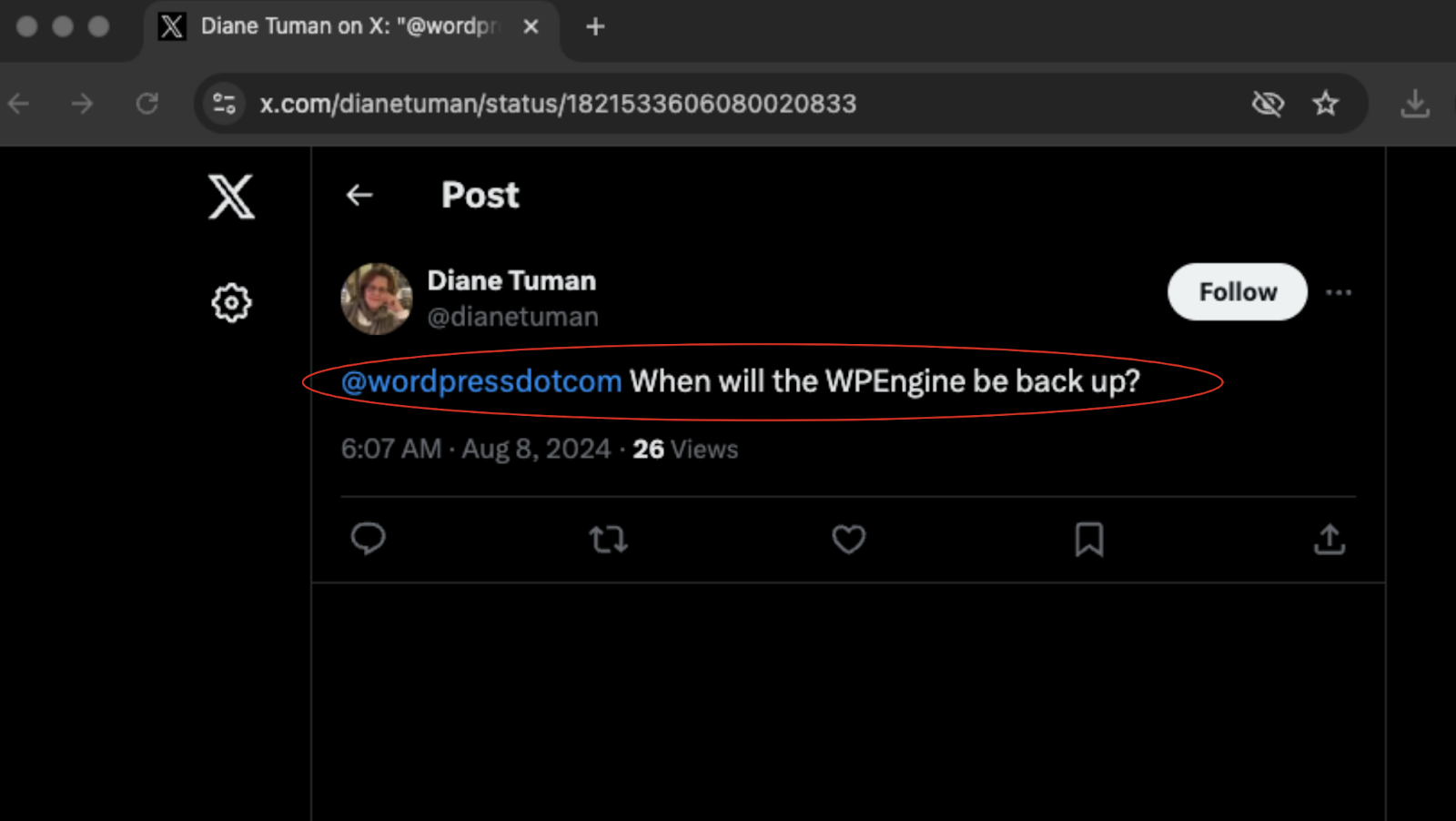
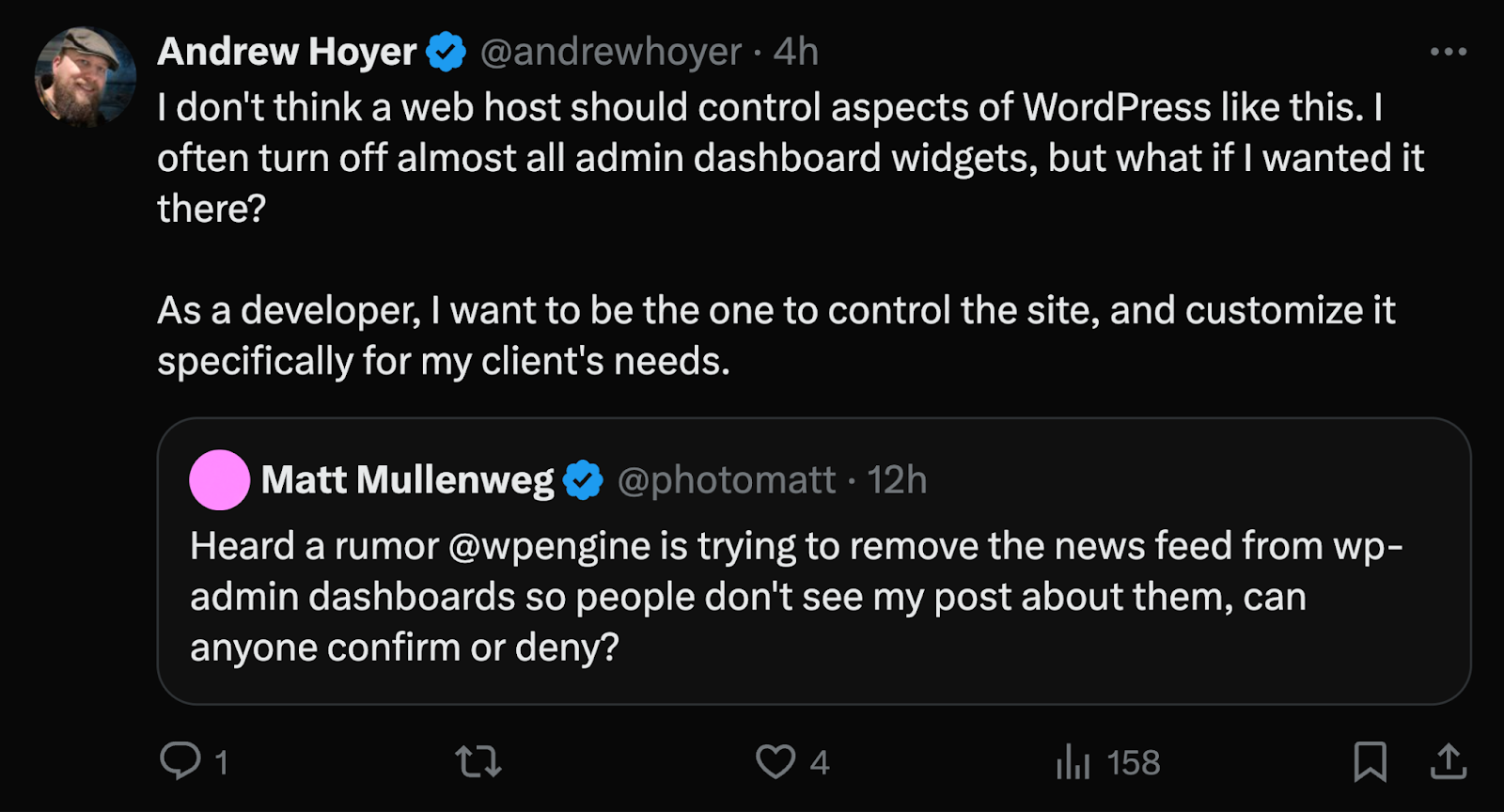
Matt tweeted about rumors that WP Engine removed the news feed from wp-admin dashboards. Some users confirmed that the whole WordPress News Metabox has been removed from the WP Engine dashboard but is still available in Local.

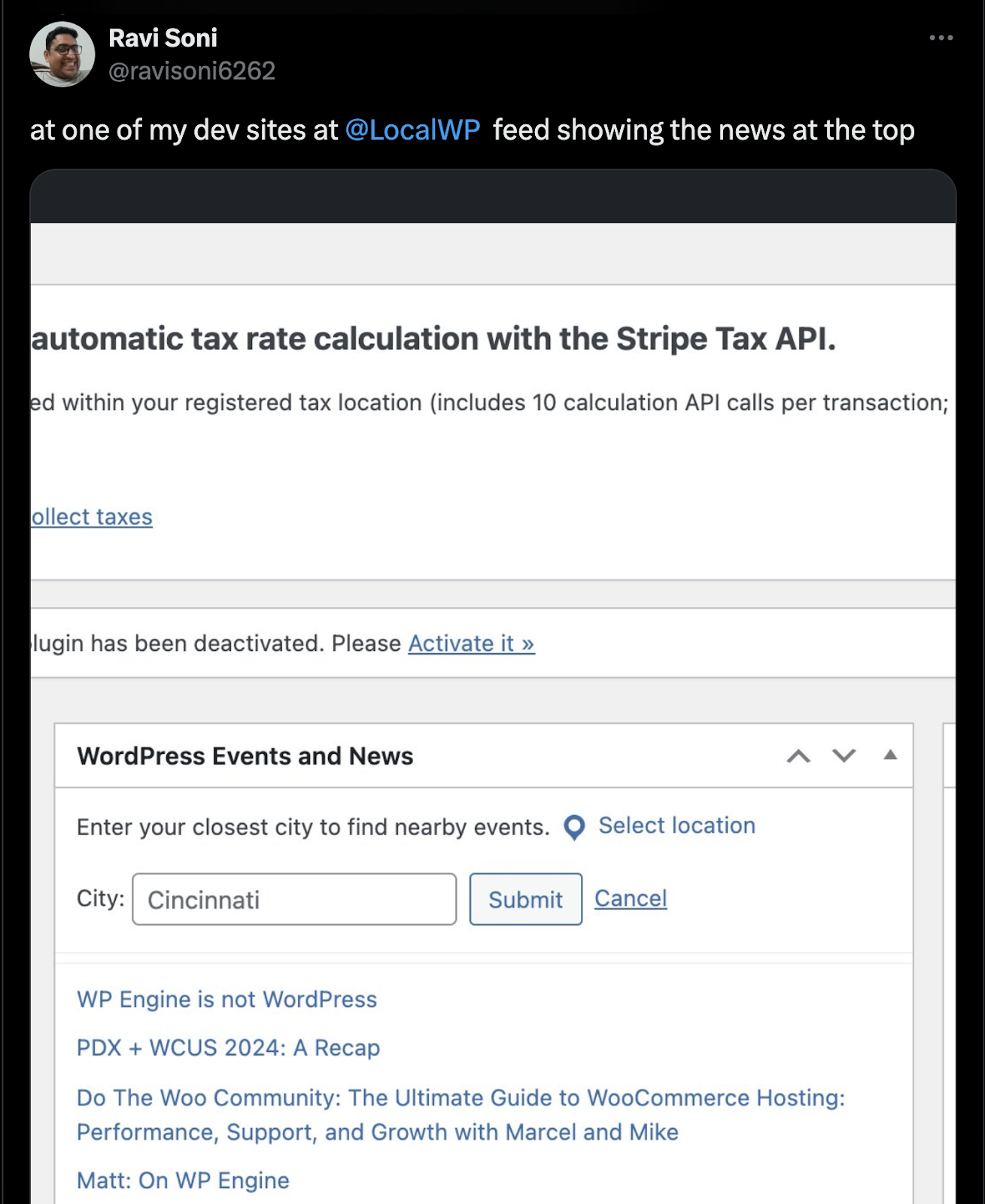
Users were divided on the widget’s importance, but several people expressed dissatisfaction with WP Engine’s move.

WP Tavern Articles Missing?

A Reddit post alleged that several WPTavern posts had disappeared after the WC US Q&A session. However, WPTavern founder Jeff Chandler debunked the claims, stating, “With some help, I conducted a thorough investigation and I can confidently say that not only were those posts not deleted, they never existed.” The Reddit post was later deleted.

(This concludes Part 2. Stay tuned for Part 3.)

22 Comments

22 Comments

  • Author
    Posts
    • It’s disheartening to see tensions rise within the WordPress community. WP Engine’s action with the cease and desist letter shows how seriously they’re taking these allegations. Hopefully, this situation can be resolved quickly and amicably, allowing both companies to focus on their shared mission of supporting the WordPress ecosystem. Thanks for sharing this important update!

      Reply
    • It’s unfortunate to see such incidents unfold within the WordPress community, especially between two major players like WP Engine and Automattic. WP Engine’s decision to address the situation with a cease and desist letter shows their commitment to protecting their reputation. Hopefully, both parties can resolve this issue and continue contributing to the community in a positive and collaborative way. Thanks for keeping us updated on this important matter!

      Reply
    • I’ve been working within the WP ecosystem for two decades… WPE’s recent moves are pure trash… and Matt/ic have ever right to seek justice to the fullest.

      Reply
    • “This situation is certainly heating up! It’s interesting to see how the competition in the WordPress ecosystem is evolving. I hope both parties can reach a resolution that allows for healthy competition and innovation. Thanks for keeping us updated on this important issue!”

      Reply
    • Thanks for the update! This situation between Automattic and WP Engine is really intriguing. Looking forward to seeing how it unfolds!

      Reply
    • This is NOT a good move Matt. We use WPEngine’s LOCAL for developing our WordPress websites. And it’s free! Therefore as far as I am concerned, they actually are contributing to the WordPress open source project. Additionally, you aired your dirty linen when we were expecting a “State of the Word” type presentation at WCUS.

      Disclaimer: We do not host with WPEngine, as we actually have a much better hosting provider who provides superb support.

      Reply
    • I imagine that one hurdle for Automattic will be all the times that Matt Mullenweg has called something a managed WordPress or hosted WordPress provider.

      It’s likely hard for Coca Cola to protect its trademark if the CEO has for 20 years been pointing to generic sodas and recommending people to drink any Coke they want.

      Reply
    • Time for the DOJ to get involved. Automattic needs to be broken up. Both WordPress and the wordpress.org repository needs to be freed from Matt and made truly independent.

      Reply
      • Agree 100%. Matt and his ego are completely out of control.

        But also, WP Engine calling itself “WordPress Engine” is definitely a violation (and their hosting is terrible).

        This is fun!

        • sits back with popcorn *
        Reply
        • True. I’ll never use WPE for hosting, However, everyone in the WP ecosystem from devs to freelancers to agencies use WordPress and WooCommerce in their sales and marketing materials. I guess everyone is now at risk and a target.

          Reply
      • “Time for the DOJ to get involved…Both WordPress and the wordpress.org repository needs to be freed from Matt and made truly independent.”

        You obviously misunderstood the role of DOJ. If you are referring to anti-trust laws, then you should know that is not intended to make legal entities, private or public, “truly independent”, as you say it. WordPress belongs where it should.

        You are free to create your own. No one is stopping you!

        Reply
    • Mullenweg needs to go. We can no longer trust content from WordPress.org. I guess we’re lucky he didn’t silently modify updates to inject messages into the 1.5M sites WP Engine hosts? Should we be thankful all he did was block access?

      Who’s next? BlueHost? Kinta? SiteGround?

      This is catastrophic. There is no way to begin to rebuild trust in the WordPress platform if Matt is connected in any way.

      ps. I’m a core contributor, but I’m not using my real name for fear of retribution.

      Reply
    • So now WPE are saying: “WordPress.org has blocked WP Engine customers from updating and installing plugins and themes via WP Admin”

      So who is being penalised here? Regular people and devs become collateral damage in the fight between egos.

      Reply
    • So the latest move in this saga is that WordPress.org has blocked WP Engine customers from updating and installing plugins and themes via WP Admin. Any updates or installs have to be performed manually and any automatic updates to plugins just won’t work.

      https://wpenginestatus.com/incidents/640187

      This is not an attack on WP Engine but it’s customers who are loyal WordPress users.

      As the CTO of a multinational agency with many 100’s of websites hosted with WP Engine I’m now forced in to considering not only moving from WP Engine but to a different CMS exosystem altogether.

      We, the end users, should not be put in this situation.

      Reply
    • Let me say this. All the people angry at Matt aren’t really following along here. We hvae to look at the far, far, far bigger picture.

      First, I’m a dedicated and passionate WordPress user. I’ve run three different WordPress Meetups. I’ve spoken at three different WordCamps over 20 times. I own the freemium WordPress plugin, Radio Station, and I have worked for AIOSEO in the past.

      Second, I’m a WP Engine customer and a Member Agency Partner.

      Third, I also own the trademark, “netmix” for broadcasting audio/video over the Internet.

      Here’s how I see it.

      WP Engine was one of the coolest startups in the extensive WordPress ecosystem. They kicked ass over all the other hosting companies with an elegant user experience, the ability to spin up three environments, the ability to easily backup and restore, and the ability to fo a lot more than most other hosts who have had to now catch up. Automattic even invested in WP Engine early on.

      In 2019, WP Engine announced $132M in revenue. Today, online sources say WP Engine’s revnue is at $400M and it’s growing 20% per year. And, WP Engine received an additional $250M in venture capital from Silver Lake.

      WP Engine’s valuation has to be up over $1B now. I don’t know this to be true, but the numbers suggest it’s probably accurate.

      WP Engine has built its entire business around hosting and supporting those of us deploying WordPress as our CMS of choice for our clients. We pay WP Engine a lot of money to do that and do it reasonably well. WordPress is a free, open-source software that anyone can download and deploy on a server to the world. However, as an open-source software, it can only get better with the financial and technical support of larger companies with a lot of revenue that can afford to give back. WP Engine, making $400M in revenue and quite possibly valued at a billion dollars or more, only gives back 45 hours a week.

      Have they sponsored WordCamps? Yes. But this is a marketing function and not foundational support. It pays for WordCamps through the WordPress Foundation but doesn’t necessarily go into WordPress development. You’re sponsoring WordCamp to get in front of WordPress users to increase the revenue and uiltimately the valuation of your company, which will someday be sold again on the backs of a free software.

      One website I read suggests WP Engine’s revenue is already $1B. I don’t know about that, but millions of sites are hosted on the platfom and it’s far and away the leader in the space.

      Yes, they’ve acquired plugins like ACF or themes like Genesis. But that’s not a contribution to the WordPress Foundation. That’s an acquisition to provide the tools that WP Engine customers are asking for. WP Engine needs to do that to stay competitive. Sure, and acquisition makes some developers rich, but there’s still a cost in supporting each of these products that WP Engine takes on, which ultimately makes their offering more valuable over their compeitiros. It’s not altruistic, by any stretch of the imagination.

      Now, factoring the hundreds of millions of dollars WP Engine makes off the backs of those who build the software for free and get compensated in other ways, they are also using the WordPress trademarks in their marketing and on their web portal. Matt – who is fronting the WordPress Foundation as its Director – offered WP Engine a license to use the very valuable trademark. Anyone who wants to use the word mark or logo in their marketing materials should pay a license fee. Some people on X are calling this, “extortion.” But it’s not. Here’s why.

      I own a trademark. I’m required to police my mark and defend it, lest I lose it to someone else who can then say to the USPTO, “we used it and they didn’t file against us, so it must mean they don’t care and we’ll just go on using it.” An entirety, individual or otherwise, MUST DEFEND THEIR MARK or risk losing it. The WordPress Foundation must NOT RISK losting their mark, so asking for a license fee IS NOT EXTORTION. It’s the WPE’s legal right to ask for a license fee.

      Now, if a $400M ARR company possible valued at $1B says they don’t want to pay your license fee when they are using the word mark and logo mark in multiple ways, that’s a problem.

      So, WP Engine doesn’t want to pay a license fee for use of the trademarked term or logo, nor do they want to offer a meaningful development contribution to the software they deploy to make yacht and mansion money.

      Now, the escalation of this war just hit me as a WP Engine customer. WPE turned off access for WP Engine to offer its customers all of the benefits from connection to the WordPress.or library to get them, plugin, and core updates. That’s a huge blow to someone like myself who can’t look for other options or migrate elsewhere because of time and resource constraints. I know I’m under the thumb of two big WordPress companies, but if WPE steps back and lets WP Engine do this, then they all do it and that would severely impact WordPress overall.

      That being said, I am of the mindset that I will wait it out But WP Engine has to pay something for the trademarked term and logo they are still using today. WP Engine is no longer your baby brother or sister just learning to walk. They’re a 25-year-old now in the big leagues. Don’t feel bad for them. This is the cost of doing business. They need to pay it and move on.

      Remember, WordPress was here light years before WP Engine was anything. They do need each other in many ways, but people easily migrate hosts but not CMS systems. Who has the upper hand here, I don’t know. But I hope the WPE is fairly compensated for WordPress.

      Reply
    • Making this all about Matt’s style misses the point. There is a bigger problem.

      This is really not about competition. It is about contribution…

      This is a big problem with all open source software, not just WordPress. Most companies do not contribute significantly.

      check this:Commons Clause Stops Open Source Abuse
      https://www.linkedin.com/pulse/commons-clause-stops-open-sourceabuse-salil-deshpande

      Reply
    • Yeah..No, this is not gonna fly one bit.

      Because the company used WP, which is allowed, customers are confusing it and using WordPress, in Reddit posts no less. What about the thousands of other “WP”-abbreviated plugins, themes, tools, and businesses?

      As a WordPress professional, my first thought after this activity by Matt is not to migrate my hosting over to his company, but to begin researching contingency plans for moving all my clients over to new website builders.

      I guarantee that people will remember this, and feeling like you can’t work with a third-party WordPress provider is going to force people to go back to non-managed hosting, just to avoid being blocked someday.Some people at least, others will look for new options. E-comm will move to Shopify, and other basic sites will go to the better, newer alternatives.

      Reply
    • Collin Mattgomery also got a Cease and Desist when using the wrong logo and lingo.

      Reply
    • Thanks for the update.

      I have hated Mullenweg since he bought the Thesis domain for no reason. Just to harass Chris Pearson.

      Mullenweg is trying to make WP engine responsible for users using WordPress’ intellectual property. Won’t work. It is just a hot air counter move.

      Reply
    • Sadly this will simply push more businesses to switch to alternative platforms such as Wix, even if it means they will have to pay to redevelop their applications, because business continuity is more important than any philosophical affiliation.

      Reply
  • The topic ‘Automattic Responds to WP Engine’s Cease and Desist with Legal Action’ is closed to new replies.

Newsletter

Subscribe Via Email

Enter your email address to subscribe to this blog and receive notifications of new posts by email.

Get updates from WP Tavern

Subscribe now to receive email updates directly in your inbox.

Continue reading