Nick Hamze’s Call to Make WordPress Themes Weird and Exciting Sparks Accessibility Discussion

Nick Hamze has called for making WordPress themes exciting and the web weird again. “WordPress desperately needs your creativity, your weird ideas, your willingness to break the visual rules. The future of the web shouldn’t be a monochrome landscape of identical layouts.”, he said.

He believes there are plenty of good themes in the Repository but no great themes with “designs that break the mold and spark excitement.” 

We need more themes that make people say “Wow!” or “That’s different!” rather than “That’s clean and professional.” The web needs more personality, more risk-taking, more fun.

According to him, great themes should:

  • Have a distinct point of view
  • Embrace specific aesthetics boldly
  • Design for specific use cases
  • Break some rules thoughtfully

Hamze’s call comes amid growing uncertainty about the future of WordPress themes. While the repository now hosts over 13,000 free themes, recent community discussions have often cast a grim outlook.Some of the discussions/articles published on the fate of themes include:

Vova Feldman of Freemius too recently highlighted the stagnation in the WordPress theme market: “The WordPress Theme Market is in big trouble! Over the past six years, the annual single-site pricing for themes has shown little to no growth. In fact, the average price has decreased by 9%, dropping from $55.78 in 2019 to $50.75 in 2024.”

Many will remember the excitement generated by the Ollie theme, but it faced pushback from the Theme Review team. Though Matt Mullenweg, Josepha Haden Chomphosy and Justin Tadlock supported the theme, in the end, it was featured on the repository only after dropping its innovative onboarding features.

Accessibility Challenges

Amber Hinds, CEO of Equalize Digital (the team behind the Equalize Digital  Accessibility Checker plugin) noticed some accessibility issues with Hamze’s post and she drew attention to them. She said, “WordPress themes need more #a11y and expected interfaces that convert. Not “weird” designs that confuse people or kill time on site.”

Matt Mullenweg joined the conversation and replied, “You’re tipping into net negative contribution territory. Like at what point do you say a Rothko painting isn’t high contrast enough?”
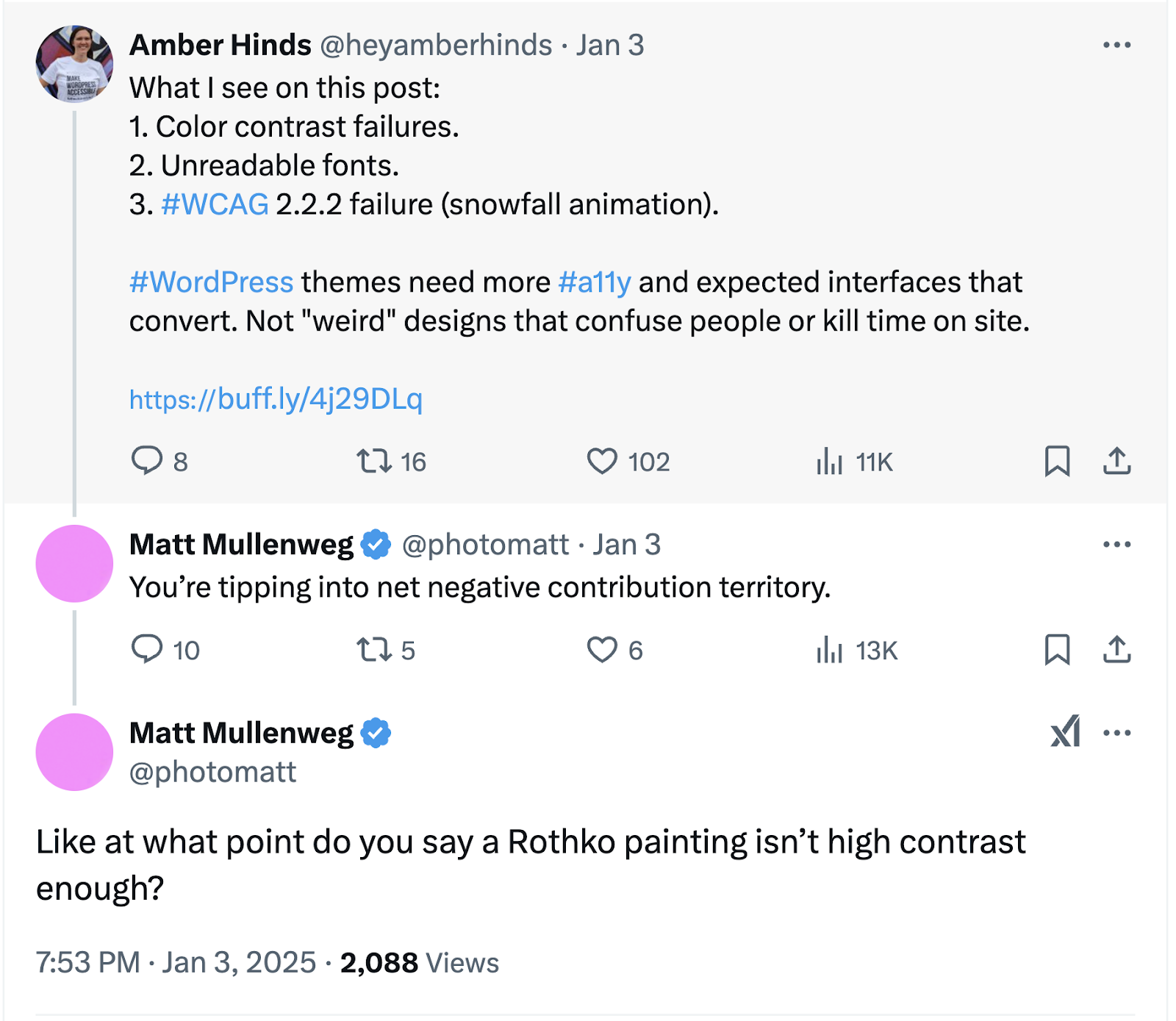
Tweet from Amber Hinds about accessibility issues with Hamze's post  and replies from Matt Mullenweg.

However, this sparked backlash. Katie Keith of Barn2Plugins questioned, “Why would the leader of the WordPress project say something so disrespectful to one of the community’s top accessibility experts simply for highlighting some accessibility issues? THAT is tipping into net negative contribution territory.”

WordPress developer Earle Davies also shared his thoughts, “Wonder why accessibility in WordPress sucks? When experts highlight accessibility flaws, it’s considered a net negative contribution by the leader of the project. No surprise a8c employees argue why they choose design >accessibility. WP/GB accessibility sucks. Indisputable fact.”

Accessibility Expert Alex Stine tweeted, “Matt has always taken this stand-offish approach to accessibility and I quit trying to figure out why.” He also said, “Accessibility and inclusion are important. Sure, themes should be eye popping fun. That doesn’t mean they shouldn’t be accessible too.”

Accessibility Advocate Anne Bovelett added, “If a theme is not accessible by contrast, it may look like a Porsche Carrera to the site owner and a good part of the visitors, but it will be a Porsche with windows that can’t be seen through from inside nor outside with doorknobs that won’t budge, to a large percentage of visitors.” She also shared her YouTube video showing examples of how many people experience the web and suggested organizing Design Days like Core Days. 

Designer Brian Gardner had this to say: ” I’m all for creative WordPress themes—whether bold and quirky or plain but practical. As far as I’m concerned, they should ALL be accessible. At a bare minimum, every theme should pass basic color contrast requirements.”

“Rothko should be fine as long as no one needs to access the painting to order medical supplies or pay their water bills. Although, a text/audio alternative to the painting is very beneficial for those with low or no vision.”, tweeted Steve Jones, Co-Owner and CTO at Equalize Digital.

Jenni McKinnon, CEO of WP Pros(e) asked, “If the Rothko painting was on a website, then wouldn’t the WCAG point to what is (or isn’t) “high contrast enough?”” while Courtney Robertson of GoDaddy emphasised: “Democratizing publishing is for all. WordPress must ensure no one is excluded from creating or consuming content.”

Kevin Geary of Digital Gravy also does not support Nick Hamze. He said, “WP “themes” are dead. It’s a dead concept. If you don’t realize this, you’re completely out of touch with how sites are built and managed. It’s especially antithetical to the fundamentals of a block editor….WP needs actual leadership and real improvements to the software. We’d all LOVE a “sanitized and professional” wp-admin right about now. “Weird themes,” not so much.”

According to Carolina Nymark of Yoast (former team representative for the Themes Team), “Themes can be art and experimental and still be accessible and high quality. You just have to decide that is what you want to build.” And for WordPress developer Brian Coords, “True creativity often thrives within constraints. Weird for weirdness sake is not art or self-expression. Creating something meaningful that inspires a shared experience between people (regardless of how they navigate the web) should be the ideal.”

Discussions are still going on about accessibility. Meanwhile, the U.S. Federal Trade Commission (FTC) fined AI accessibility startup accessiBe to pay $1M for misleading advertising. 

11 Comments

11 Comments

  • Author
    Posts
    • I have to admit I get pretty tired of “which is the best theme for…” conversations. And I also lament the mobile-ification of site design, although it’s true that most sites are visited on phones.

      That said, most halfway decent page builders (even Gutenberg) are reaching a point where headers, footers, partials, and CPT pages are just something else to be designed from scratch with the builder. The strong benefit being that designers can just design without having to negotiate with different implementation considerations or even different implementation teams!

      As for accessibility, if you’re clever enough to design a distinctive, custom, and genuinely interesting site design then part of being clever is detecting and accommodating people with alternative abilities. If you’re going to do everything as Rothko images you can #%!#% well include complete alt text. If you’re going to implement your controls as runaway buttons you can !#%!%# well include a solidly anchored “cut it out” button. Real graphic professionals don’t just slap stuff around and call it art. (Even Rothko didn’t just slap paint around and call it art!)

      Reply
    • There is one very important word that cannot be found anywhere in Nick Hamze’s article.

      I’d wager the vast majority of visitors could not care less about the design of a website. What they want is the right content and for that content to be easily accessible. A good design for most visitors is an invisible design, one they don’t even realize is a good design as they are seamlessly presented with the content they are looking for. They don’t give a flying *&%! whether the design is “wow” or “different”. Only designers care about such things. It’s like how a movie can enthrall the audience because it has a great story coupled with the very best editing that the audience doesn’t even realize is great editing. Then come the awards season the creatives can all pat each other on the back and say what a marvellous job they’ve done.

      As for Rothko, this is just silly and pretentious. All art is wonderful and certainly has its place but again many many people would have no idea who Rothko was or what he painted, and would probably (rightly or wrongly) joke that it had been created by a six-year-old child, the nuances completely lost on them. We seem to be in an arms race of opinions at the moment in WordPress and the wider world where it’s opinions for opinions sake.

      Please Nick Hamze, would you be willing to create what you would call a weird theme, and submit it to the .org theme repo? Lead by example and then we will have more to go on than mere words calling for such things.

      Reply
    • Man the WordPress community can be so freaking up tight that it’s off putting. Not every theme needs to be designed for accessibility. The ones that come stock with WordPress sure, but otherwise what people use is their own business. If someone wants to use a non-responsive theme, with low contrast, and a gaudy color-scheme then it’s their own choice and certainly not the end of the world.

      The only person in this article that says anything worthwhile and productive is Nick Hamze:

      “WP “themes” are dead. It’s a dead concept. If you don’t realize this, you’re completely out of touch with how sites are built and managed. It’s especially antithetical to the fundamentals of a block editor”

      This is what we should be actually debating. In a world of Full Site Editing when can we move away from the old theme paradigm? It’s no longer necessary, or at worst with a little work it won’t be necessary in another year or two.

      Maybe we should be talking about moving people from designing themes to designing collections of patterns.

      Reply
    • A criticism if I may.

      Some of the linked articles here are like 5 years old (hence not really relevant).

      There’s definitely a discussion to be had about how themes are developed – particularly given the recent push by Automattic to promote “hybrid themes” – but that discussion probably isn’t well served by concentrating on Twitter soap operas about what Matt said or didn’t say.

      Reply
    • Okay… So I looked at the Nick Hamze post and the WordPress themes listed.

      They look different for sure but unless you are going to use them as is for a plumbing company website what is the main deal here???

      Themes like Psychedeli and Kawaii-Chan are not getting 5,000+ downloads a day so how many people are really going to use this theme or even know it exists.

      Reply
    • And the #EuropeanUnion wishes a happy, new Year.

      Just search for European Accessibility Act 2025 #EAA. Non-compliance can result in significant costs. Be aware, also ANY non-EU business that offers products or (digital) services to the EU market must comply with the accessibility standards.

      Think of it as GDPR on steroids.

      Reply
    • Nick Hamze’s call to make WordPress themes “weird and exciting” sparks an important discussion on accessibility. While creativity in design is crucial, it’s essential to balance innovation with user accessibility to ensure inclusivity for all visitors.

      Reply
    • Nick Hamze’s post is thought-provoking but feels disconnected from the reality of how most people use WordPress. The author romanticizes a return to a “weird,” personalized web while overlooking the practical needs of the majority of WordPress users, who often prioritize functionality, simplicity, and accessibility over daring aesthetics.

      Unfortunately, many core and Automattic developers seem to share the author’s perspective, favoring conceptual ideals over the practical realities of how WordPress is used. This disconnect often manifests in feature updates and design philosophies that emphasize creative possibilities or abstract principles over tangible benefits for everyday users. While there’s certainly a place for bold, experimental themes in the WordPress ecosystem, this prevailing mindset risks alienating the very community that sustains WordPress as a platform: regular people who need straightforward, reliable tools to manage their online presence.

      Reply
    • Accessibility and inclusion must be at the heart of any software. WordPress is a go-to publishing platform due to its accessibility and ease of use for many, including myself. As a person with a visual disability, I prefer creating accessible themes and plugins from the start rather than compromising on them later.

      Reply
    • I have worked on various projects for all types of clients, and I am sure that none of them want a weird and exciting site.

      Reply
  • The topic ‘Nick Hamze’s Call to Make WordPress Themes Weird and Exciting Sparks Accessibility Discussion’ is closed to new replies.

Newsletter

Subscribe Via Email

Enter your email address to subscribe to this blog and receive notifications of new posts by email.

Get updates from WP Tavern

Subscribe now to receive email updates directly in your inbox.

Continue reading